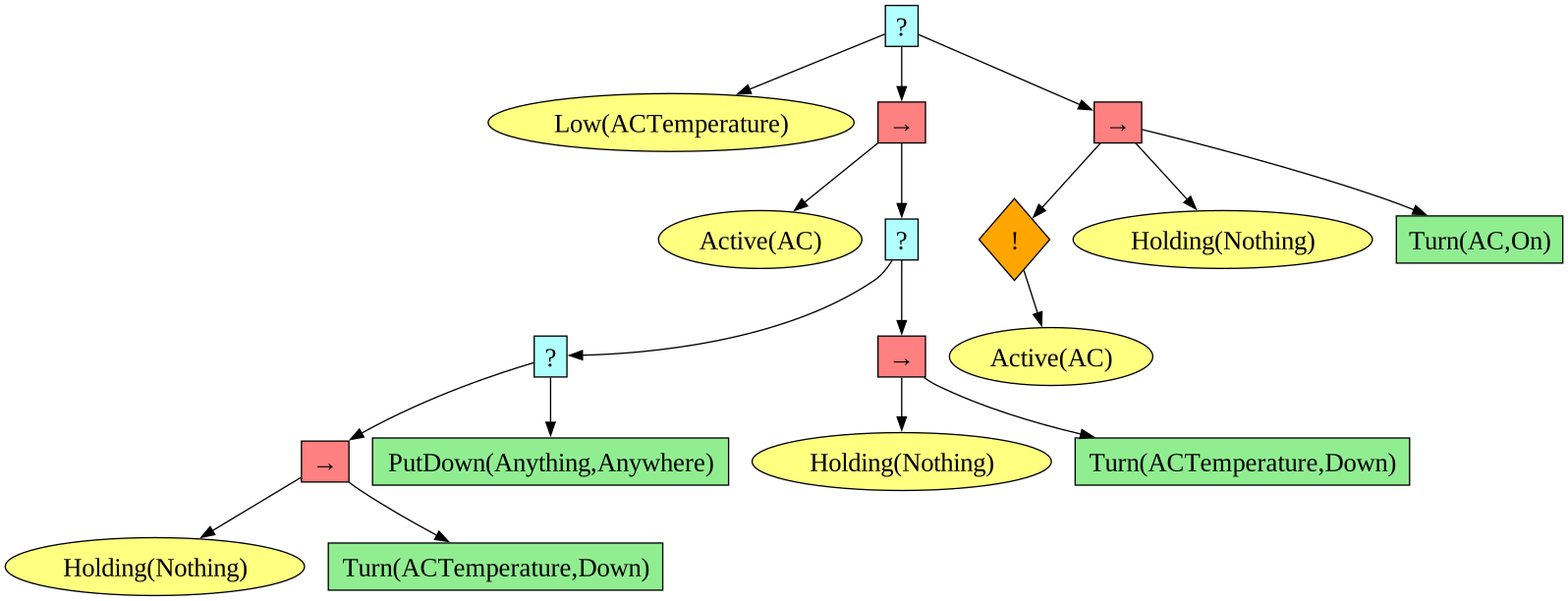
"It's quite toasty inside, could you please lower the air conditioning temperature?"
Low(ACTemperature)
Behavior Tree Generation · LLM × Optimal Planning
College of Computer Science and Technology · National University of Defense Technology
* Equal contribution · ↑ Corresponding author
Robots executing tasks following human instructions in domestic or industrial environments essentially require both adaptability and reliability. Behavior Trees (BTs) emerge as an appropriate control architecture for these scenarios due to their modularity and reactivity. Existing BT generation methods, however, either do not involve interpreting natural language or cannot theoretically guarantee the BTs' success.
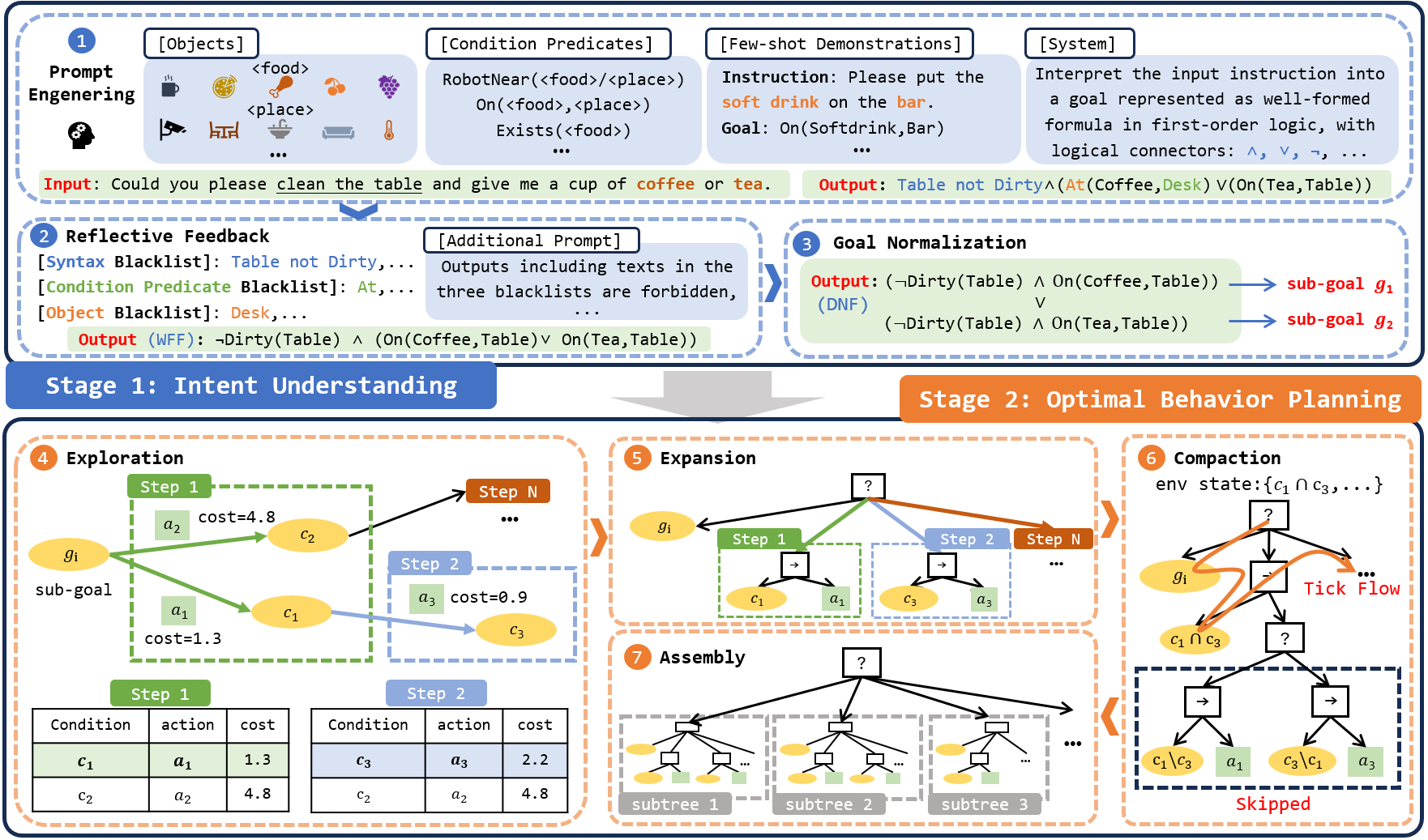
This paper proposes a two-stage framework for BT generation: first employing large language models (LLMs) to interpret goals from high-level instructions, then constructing an efficient goal-specific BT through the Optimal Behavior Tree Expansion Algorithm (OBTEA). We represent goals as well-formed formulas in first-order logic, effectively bridging intent understanding and optimal behavior planning. Experiments in hospitality industry settings validate the proficiency of LLMs in producing grammatically correct and accurately interpreted goals, demonstrate OBTEA's superiority over the baseline BT Expansion algorithm in various metrics, and finally confirm the practical deployability of our framework.
A two-stage framework: LLM-driven intent understanding meets optimal behavior planning.
Three tiers of instructions — from a single intent to compositional logical goals.
"It's quite toasty inside, could you please lower the air conditioning temperature?"
Low(ACTemperature)
"Could you please not put the carton drink on table one and close the curtain?"
~On(Softdrink, Table1) ∧ Closed(Curtain)
"Could you please turn on the coffee machine at the bar, and make sure the floor is clean or the tube light is off? I enjoy my coffee in a cozy environment."
On(Coffee, Bar) ∧ (IsClean(Floor) ∨ ~Active(TubeLight))
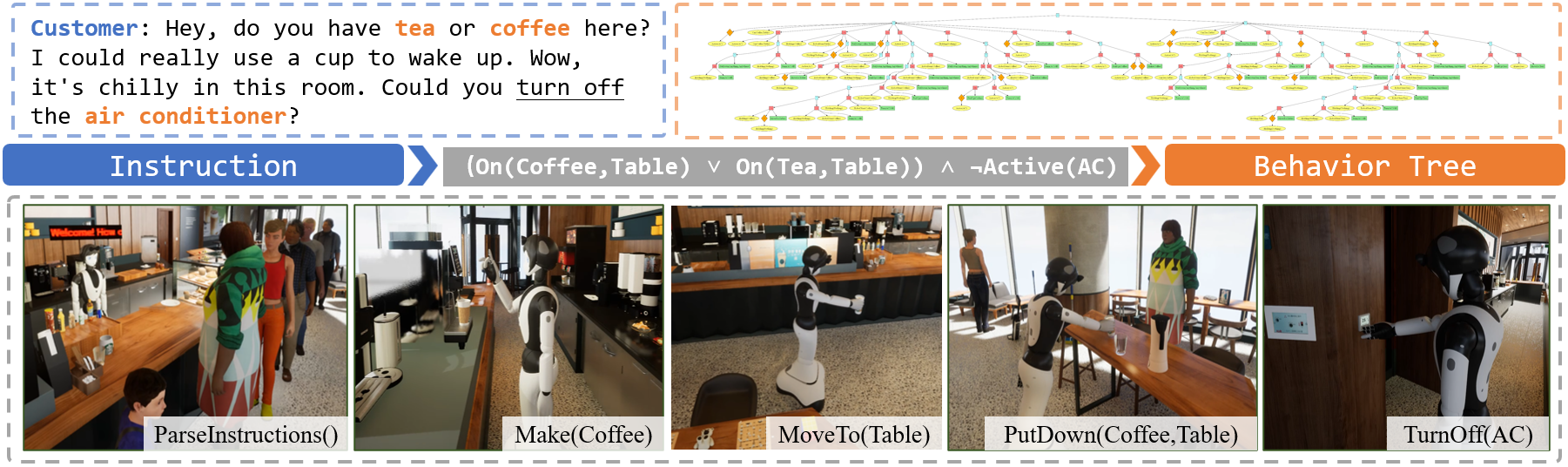
Live demonstration exhibited at ChinaSoft 2023.
If you find this work helpful for your research, please consider citing:
@inproceedings{chen2024robowaiter,
title = {Integrating Intent Understanding and Optimal Behavior Planning
for Behavior Tree Generation from Human Instructions},
author = {Chen, Xinglin and Cai, Yishuai and Mao, Yunxin and Li, Minglong
and Yang, Wenjing and Xu, Weixia and Wang, Ji},
booktitle = {Proceedings},
year = {2024}
}