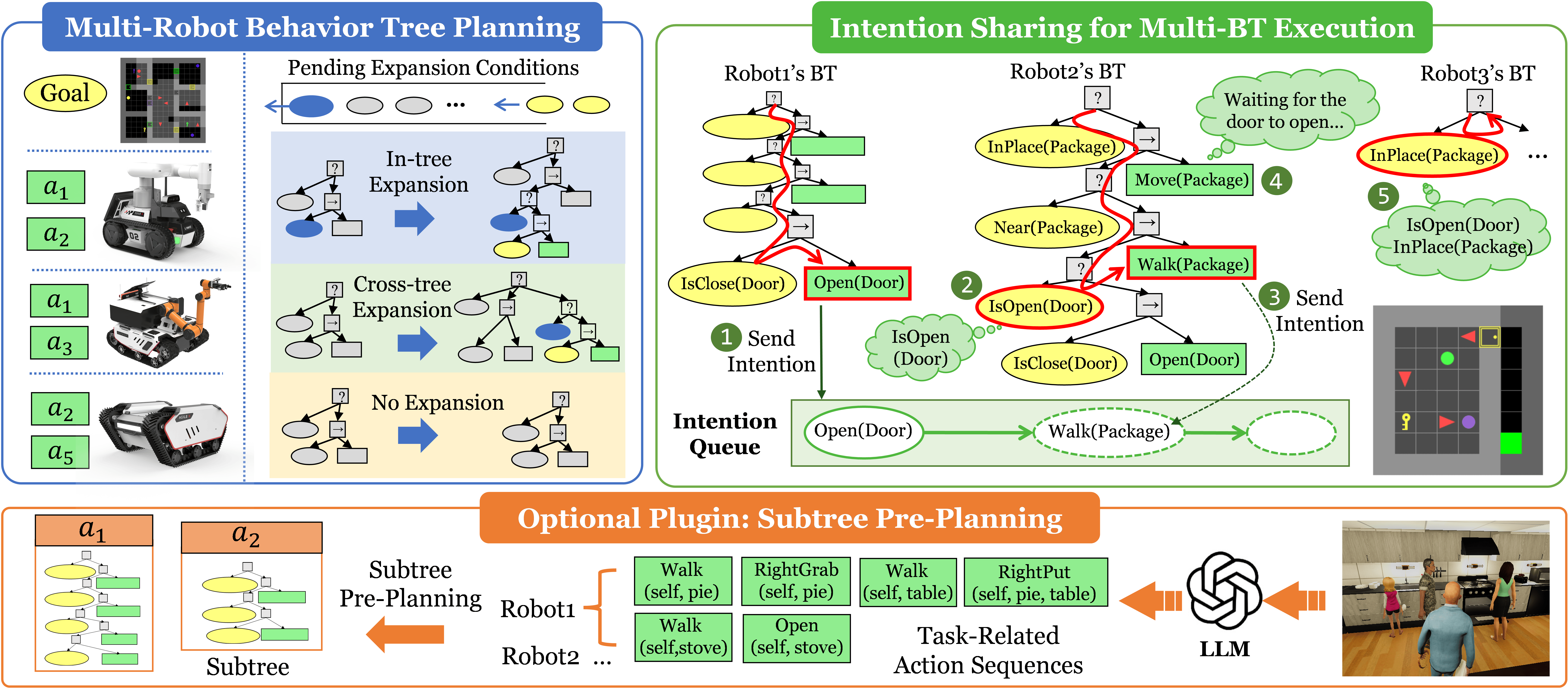
The first sound & complete multi-robot BT planning algorithm. A condition expanded in one robot's tree can be further expanded by all robots — so one robot may act to satisfy another's precondition, enabling true multi-tree coordination of heterogeneous actions.
For homogeneous actions, backup structures guarantee fault tolerance. During execution each robot broadcasts its current action, letting others predict effects via belief spaces — eliminating redundant work and turning serial trees into parallel execution.
An optional plugin: when an LLM is available, it reasons goal-related actions per robot that are pre-planned into long-horizon subtrees. This speeds up planning, cuts communication overhead, and boosts collaboration efficiency.
Multi-robot task planning and collaboration are critical challenges in robotics. While Behavior Trees (BTs) have been established as a popular control architecture and are plannable for a single robot, the development of effective multi-robot BT planning algorithms remains challenging due to the complexity of coordinating diverse action spaces. We propose the Multi-Robot Behavior Tree Planning (MRBTP) algorithm, with theoretical guarantees of both soundness and completeness. MRBTP features cross-tree expansion to coordinate heterogeneous actions across different BTs to achieve the team's goal. For homogeneous actions, we retain backup structures among BTs to ensure robustness and prevent redundant execution through intention sharing. While MRBTP is capable of generating BTs for both homogeneous and heterogeneous robot teams, its efficiency can be further improved. We then propose an optional plugin for MRBTP when Large Language Models (LLMs) are available to reason goal-related actions for each robot. These relevant actions can be pre-planned to form long-horizon subtrees, significantly enhancing the planning speed and collaboration efficiency of MRBTP. We evaluate our algorithm in warehouse management and everyday service scenarios. Results demonstrate MRBTP's robustness and execution efficiency under varying settings, as well as the ability of the pre-trained LLM to generate effective task-specific subtrees for MRBTP.
Warehouse / home-service tasks. EC = expanded conditions, PT = planning time. Avg. LLM response 4.2 s per call.
| Homogeneity | Subtree | Feedback | EC | PT (s) |
|---|---|---|---|---|
| α = 1 | – | – | 8033.3 | Timeout |
| ✓ | – | 998.1 | 12.4 | |
| ✓ | ✓ | 384.3 | 3.7 | |
| α ≈ 0.5 | – | – | 7882.5 | Timeout |
| ✓ | – | 623.8 | 7.2 | |
| ✓ | ✓ | 267.9 | 2.6 | |
| α = 0 | – | – | 2695.5 | 20.2 |
| ✓ | – | 576.6 | 5.6 | |
| ✓ | ✓ | 146.8 | 1.4 |
          @inproceedings{cai2025mrbtp,
            title={Mrbtp: Efficient multi-robot behavior tree planning and collaboration},
            author={Cai, Yishuai and Chen, Xinglin and Cai, Zhongxuan and Mao, Yunxin and Li, Minglong and Yang, Wenjing and Wang, Ji},
            booktitle={Proceedings of the AAAI Conference on Artificial Intelligence},
            volume={39},
            number={14},
            pages={14548--14557},
            year={2025}
          }